Publish your product and set one reward offer, the terms partners promote you on: what counts as a result, what it pays, and the rules. Or request a placement from a creator, at their price.
Example reward offer: your product, what counts as a result, what a partner earns for each one (for example $25 per signup, $10 per trial or $300 per paying customer), and a result waiting for your review.
Example reward offer
Your product
What counts as a result
A partner earns
$25per signup
Review result
Approved with a reason
Who it's for
Built for products people can try from a link.
A partner channel amplifies a product that already converts on its own. If these three sound like you, it is your stage.
Self-serve products
A link is all it takes.
A stranger can go from a recommendation to a signup, a trial or a checkout without a sales call.
Signup
Free trial
Freemium
Checkout
On Pantheon: a tracked link and one server-side call from your app put every result against the partner who sent it.
Clear economics
You know a customer's worth.
So you can price a reward a partner takes seriously and still keep your margin.
Per signup
Per trial
Per paying customer
On Pantheon: set the reward once in a reward offer, and partners read it before they take a link.
Hands-on teams
You want to see what you pay for.
You would rather review results than buy impressions, and you can answer for each decision you make.
Approve
Reject with a reason
Disputes
Deadlines
On Pantheon: every result waits for your decision, and the partner sees the reason you give.
How it works
From a product page to a reviewed result.
Four steps, and the boring middle is ours.
01
You
Publish a product page
Set one reward offer
Pass the launch checklist
02
Pantheon
Lists your reward offer for creators
Gives each partner a tracked link
Tests your tracking end to end before launch
03
Partner
Reads your terms first
Shares your product with their audience
Or pitches a fixed-fee placement
04
You
Review each result, with a reason
Pay the partner directly
Build your settlement record
What's inside
Everything you need to run a partner channel, in one place.
Your products, reward offers, partners and results in one workspace. The public page and the partner terms are two separate views by construction.
Demo data
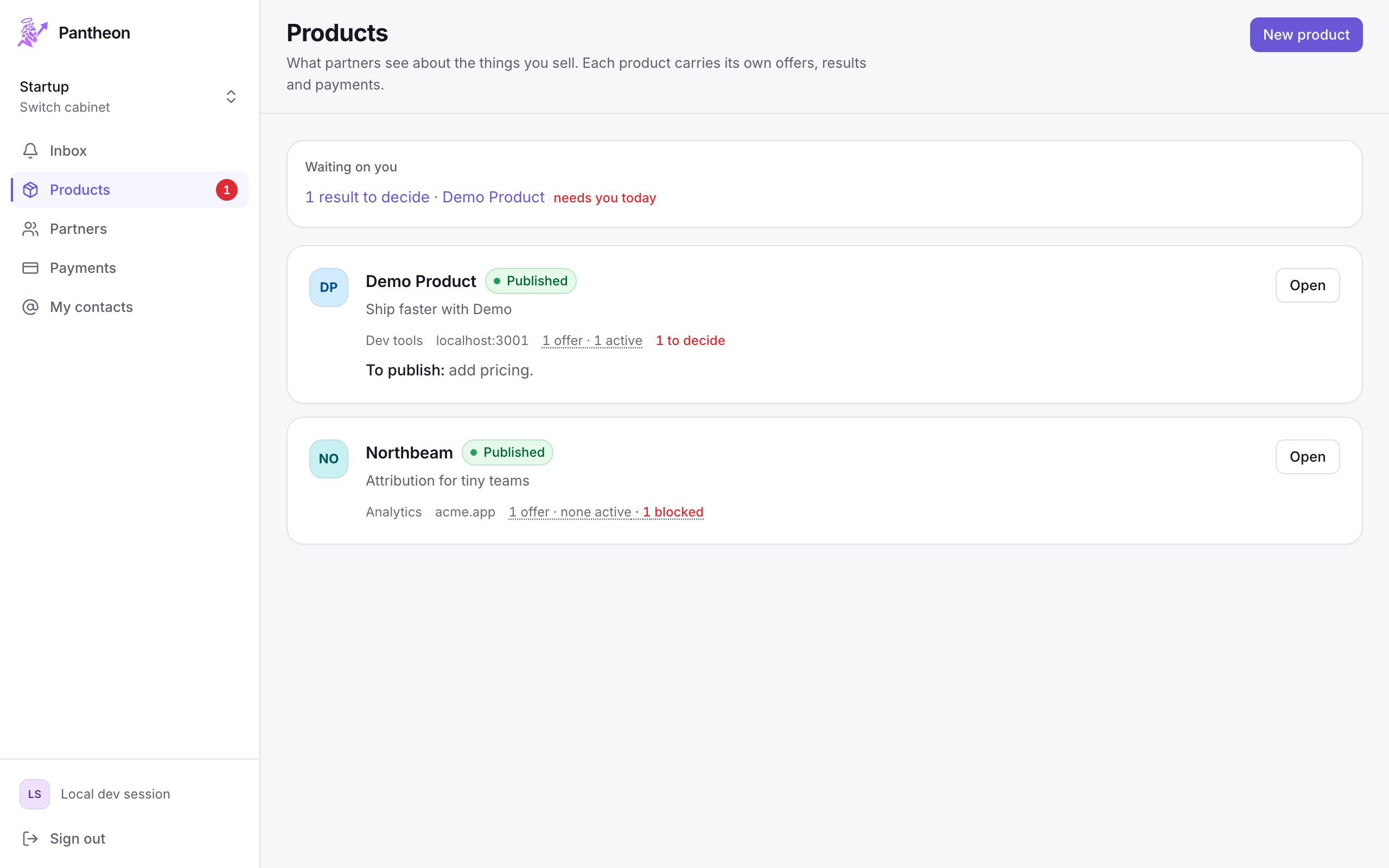
app · /workspace · Your products, each row carrying its reward offers and what waits on you
Demo data
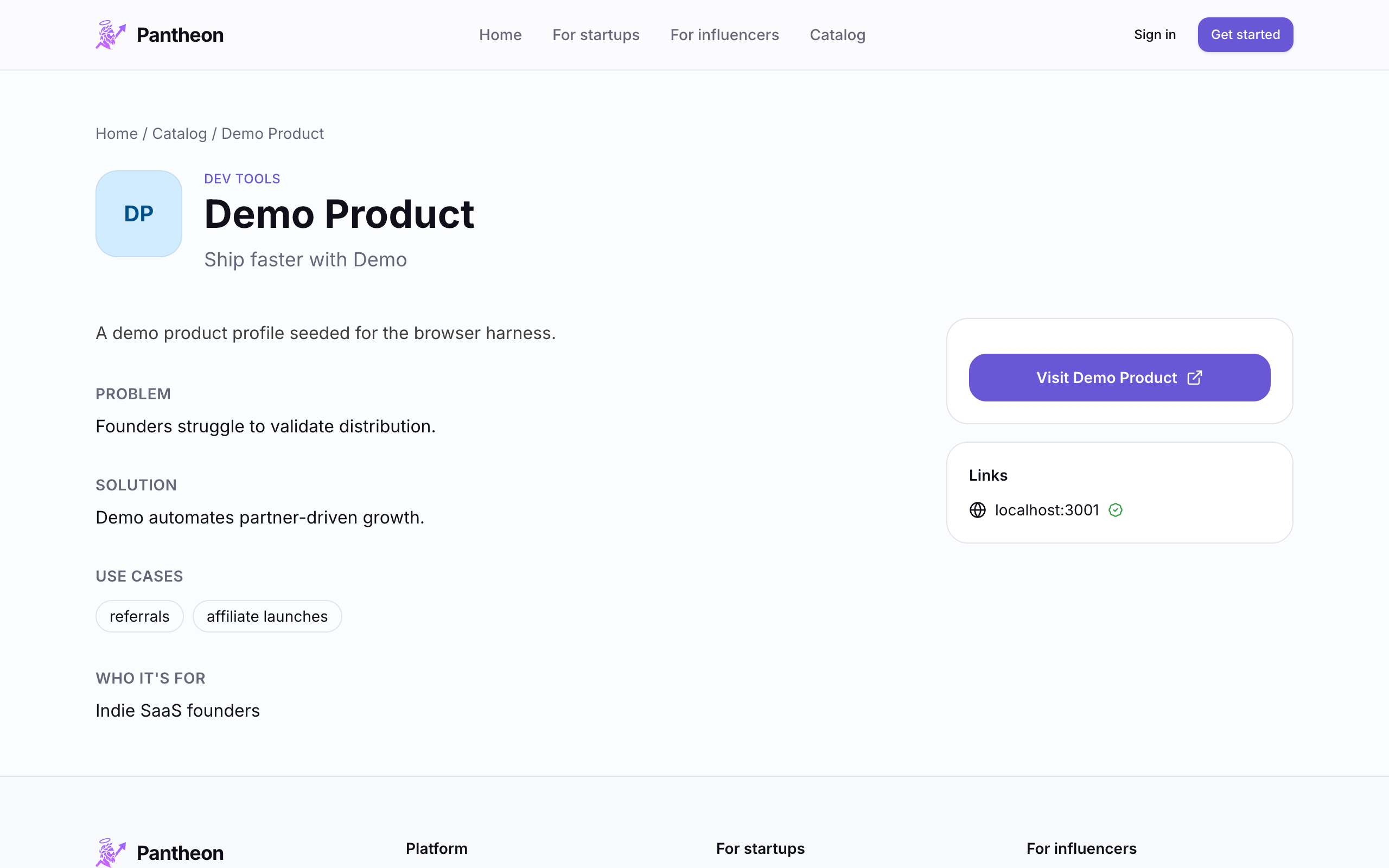
pantheon.godofstartups.com/catalog/… · The public product page: your story, no commercial terms
Demo data
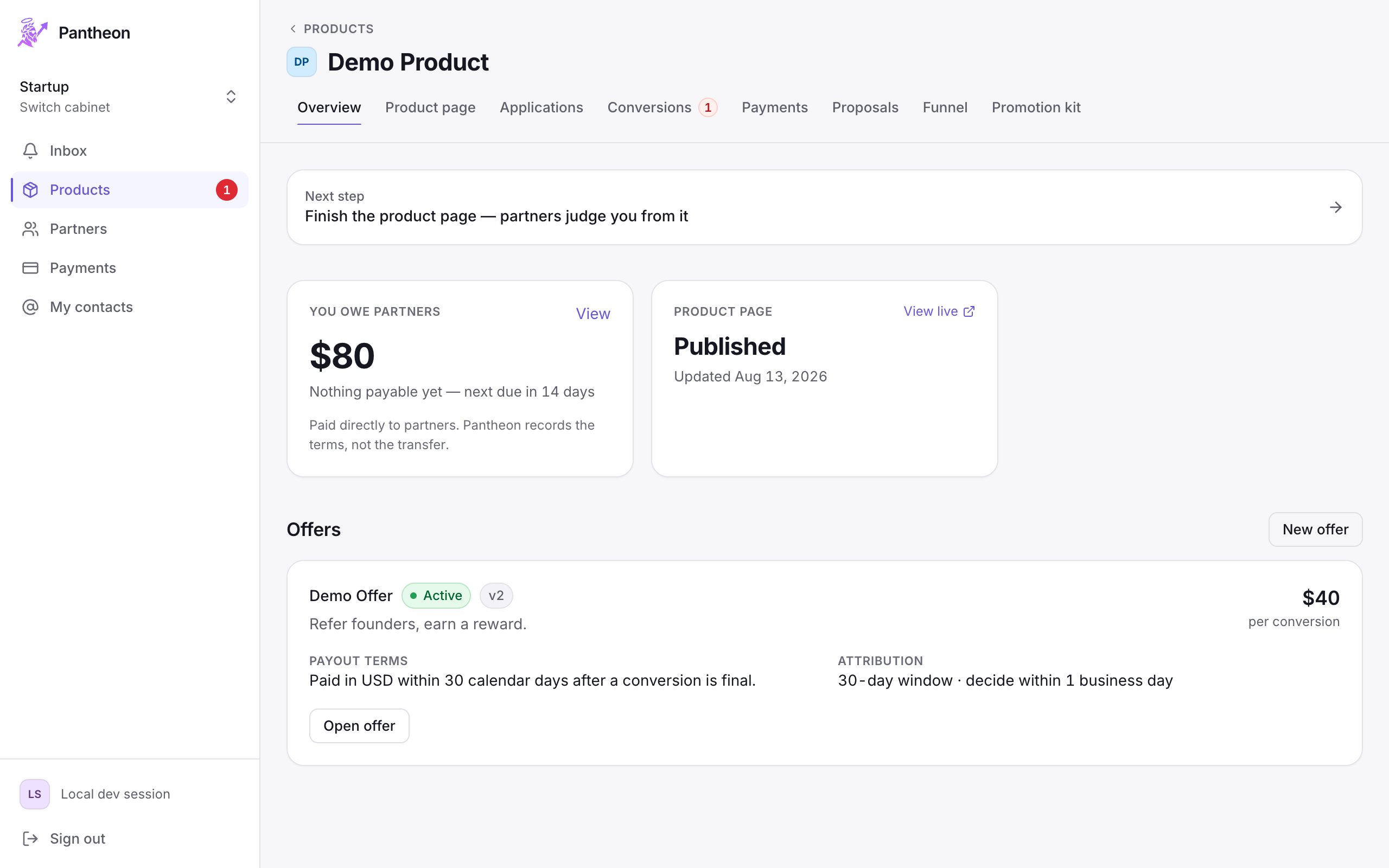
app · /workspace/your-product · The product overview: reward offers, launch checklist and next step
Your partners, your money
You pay partners directly. We keep the record both sides read.
Pantheon is not in the payment path and takes no cut of what you pay partners. One flat launch price covers the channel.
$9/mo launch price
Charged once a reward offer is live. Drafting and publishing are free. The price is temporary, and we'll announce a change before it happens.
No cut of payouts
What you pay a partner goes from you to them, on the terms you both accepted. Pantheon takes nothing from it.
Versioned terms
An edit makes a new version and applies from then on. The version a partner accepted stays frozen and readable, so neither side argues from memory.
A deadline on you too
Your reward offer names your response window. Miss it and the result is approved automatically, not left hanging.
Q&A
Good questions. Straight answers.
Is it too early for my product?
It is if your sales close in calls and contracts, with no online path a stranger can walk from a link to a signup. It is if your margin can't fit a partner reward: if paying $40 for a real customer hurts, fix the economics first. And it is if you can't yet say what a qualified signup is for your product, because you would be reviewing results with no yardstick. A partner channel amplifies a product that already converts. It cannot replace that.
Do you already have creators waiting? Where do partners come from?
We are early, and we won't inflate it with a counter. Partners come from four places: creators browsing the catalog of reward offers, creators you find in Discover Partners and invite, people you already know who join through your invite link, and creators who pitch you a fixed-fee placement. Your invite link works from day one.
What is the difference between a reward offer and a promotion offer?
A reward offer is yours: the terms you pay partners on for promoting your product, through a tracked link they share. A promotion offer is a partner's: a placement they sell on their own channels, paid as a fixed fee or in barter and agreed deal by deal.
Can I request a creator's placement myself?
Yes. In Discover Partners you filter creators by topic and audience and request a placement they sell, at the price they set. Their acceptance shares their contact with you, you pay them directly on delivery or on acceptance, whichever the request says, and a request nobody answers expires instead of hanging forever.
Do you handle the payouts?
No. Today both sides settle directly (bank, PayPal, whatever you two agree), and Pantheon records what was declared: the terms, the decision on every result, and what each side confirmed receiving. A protected payment mode (funds reserved before delivery) is planned but not shipped, and until it ships nothing on this site promises it.
What stops a partner from sending junk traffic?
You review every result yourself, and one you never review is decided by the response window in your own reward offer. Each conversion carries deterministic risk signals: a repeat IP, a bot user agent, a conversion faster than a person could manage, or a click from your own domain. A partner's own test clicks are never payable. Rejecting is one click with a standardized reason.
What keeps me honest when I review results?
Every decision needs a reason, the partner sees the same history you do, and they can contest a rejection, and a dispute has a recorded outcome. How you settle accumulates into a record partners read before joining: what they confirmed receiving, anything past its deadline, open disputes, and once there are enough of them, how close to your own deadline you pay. The system is built so neither side has to take the other's word for anything.
Do I need to integrate an SDK or write code?
No SDK. A visits-only reward offer needs no code: the tracked link counts every visit. To reward signups, your server makes one HTTP call when a referred visitor signs up, with the click ID from the link and the reward offer's own key. Before launch, a test link walks the whole chain and names the step that broke, if one did.
What does $9/mo actually buy, and what happens to the price later?
$9/mo is a temporary launch price, charged only once a reward offer goes live; publishing and drafting are free. It includes the published product page, one active reward offer, tracking, the result ledger and partner management. The price will rise later and we'll announce it before it does; we are deliberately not promising forever-grandfathering we haven't decided.
Can I run Pantheon alongside an existing affiliate tool?
Yes. There is no exclusivity. Attribution here is last-eligible-click within your reward offer's window (30 days by default), scoped to Pantheon links, so it does not fight your other channels' tracking.
What do partners see about my product before I approve them?
Two different views by construction. The public page carries your product story and no commercial terms. Your reward offer (reward, rules, attribution window) lives in a gated catalog visible only to signed-in creators, never on your public page. Terms are versioned: a partner keeps the version they accepted even if you change it later.
What happens if I unpublish my product or leave?
Unpublishing automatically pauses reward offers that depend on the public page, so no partner keeps sending traffic to a page that's gone. Obligations for already-approved results remain between you and the partner; leaving doesn't erase what was decided.
Why would a creator promote a product nobody knows?
Because the terms are readable before they commit, the results are visible to them (not just to you), and their history here builds a reputation. And if the performance deal doesn't fit their format, they can pitch you a fixed-fee placement instead. You'll see it in your inbox and decide with the same recorded trail.
Launch your partner channel
Registration is free. Drafting and publishing cost nothing, and the launch price starts when a reward offer goes live.